The Skills You Need to Make Mission-Critical PHP Possible
Modern PHP powers websites, APIs, and applications essential to your business. From core PHP fundamentals to secure coding and performance tuning best practices, your developer team needs practical skills you can trust in production environments.
ZendPHP training courses are built around real-world needs and flexible learning styles. Our free, on-demand, and instructor-led PHP courses support every stage of growth, whether you’re new to PHP or an advanced developer. Find your best option below.

Free and On-Demand PHP Training
Zend offers paid and free on-demand online PHP courses. These PHP training options are great for beginner or intermediate PHP teams. They cover everything from how to install PHP to how to build interactive web forms. Explore our catalog of free and on-demand online PHP courses below.
Certify Your PHP Expertise
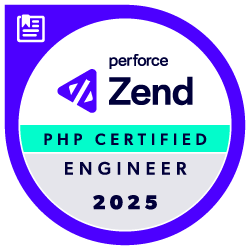
The Zend PHP Certified Engineer exam recognizes PHP expertise, acting as a measure of distinction in a competitive job market. Set a consistent knowledge level for your team, distinguish yourself to prospective employers, and build a portfolio that stands out against the competition.
Instructor-Led PHP Courses
Available on request, instructor-led PHP courses from Zend allow your team to learn directly from live PHP experts. These sessions combine hands-on training, real-world examples, and time for questions.
Instructor-led PHP training is ideal for teams that want guided learning, deeper discussions, and focused skill growth through a structured PHP course and learning environment.
A variety of topics are available, covering everything from PHP foundations through advanced concepts. Explore options below.
Fill out this form to schedule instructor-led training or request a course on a specific topic.
Instructor-Led PHP Course Options
PHP II: Object-Oriented Programming (OOP)
$ 1295.00
EN
6 Sessions, 3 Hours per Session
ILT (Instructor-Led Training)
PHP Application Security Training Course
$ 1295.00
EN
6 Sessions, 3 Hours per Session
ILT (Instructor-Led Training)
Laminas Fundamentals
$ 1295.00
EN
6 Sessions, 3 Hours per Session
ILT (Instructor-Led Training)
PHP In-Depth: Observability Orchestration and Automation with ZendPHP and ZendHQ
$ 695.00
EN
3 Sessions, 3 Hours per Session
ILT (Instructor-Led Training)
PHP In-Depth: Unit Testing JumpStart
$ 695.00
EN
2 Sessions, 3 Hours per Session
ILT (Instructor-Led Training)
PHP In-Depth: Developing a Drupal Module
$ 695.00
EN
2 Sessions, 3 Hours per Session
ILT (Instructor-Led Training)
PHP Focus: Boost Website Performance With PHP-FPM, nginx, and ApacheQ
$ 475.00
EN
1 Session, 3 Hour Duration
ILT (Instructor-Led Training)
Complete PHP Courses, Earn Exclusive Badges
Complete Zend PHP courses, earn badges, then share your skills with the world! Every time you complete a free, on-demand, or instructor-led Zend PHP course, including online PHP courses, you earn an exclusive badge that is showcased in your profile.
Want to share your accomplishment on social media? Easily share your earned badges on LinkedIn and X directly from your Earned Badges section.
Zend PHP Training: Frequently Asked Questions
The best PHP course will depend on your team's knowledge level, availability, and learning style.
To serve as many developers as possible, Zend offers a variety of PHP courses and PHP training choices to match your needs. Choose between on-demand or instructor-led PHP courses, an onsite or online course, individual or group sessions, and more.
Each Zend PHP course is led by an expert with extensive PHP knowledge and proven experience assisting global PHP teams. Scroll up to find the right training option for you!
Yes, the basics of PHP are generally regarded as easy to learn.
However, as with any scripting language, building a more advanced understanding of PHP will take time and practice. PHP training, such as the in-person and online PHP courses offered by Zend, can help speed up your learning curve. Scroll up to peruse your PHP training options, and contact us to learn more.
Yes, you can learn PHP by yourself, but PHP courses significantly speed up the process. By taking advantage of PHP training led by a qualified instructor, such as the Zend team, you can get to work much sooner than by learning alone.
Each Zend course has been designed to guide your learning journey, help you avoid common mistakes and pitfalls, and equip you with the skills you need to successfully manage a PHP application.
Yes! Zend offers a full range of online PHP training and PHP courses ranging from beginner to advanced. Each of our online PHP courses have been developed by our expert PHP team. For more information on our available PHP training modules and to explore available courses, scroll to the top of this page and peruse your options.
Instructor-led PHP training options are also available upon request.
Yes, Zend offers beginner PHP courses and training, including instructor-led options and on-demand online options, links to which are available at the top of this page. We also offer a variety of free online PHP resources for new developers. After signing up for a beginner PHP training course, check out these blog posts:
Yes, Zend offers advanced on-demand and instructor-led PHP training. Scroll up to the top of this page to explore both on-demand and instructor-led PHP training, or contact us to discuss more advanced options. In the meantime, check out these free online PHP resources:
- Report - PHP Landscape Report
- Report - Past Editions of the PHP Landscape Report
- On-Demand Webinar - Developing Robust 12-Factor Web Applications: Best Practices and Strategies
- Blog - How to Install (and Configure) Ansible to Deploy a PHP Application
While PHP is regarded as very easy to learn, you will need more than 3 days to learn the language.
The amount of time required to learn PHP will vary from person to person, however with diligent study, most can learn the basics within three to six months. PHP training, such as the courses offered by Zend, are an ideal place to get started. Scroll to the top of this page to explore our PHP training for beginner developers.
Zend PHP courses are designed to improve and grow your PHP knowledge base. For specific questions relating to Zend products (such as ZendPHP, ZendHQ, or the Zend Enterprise Web Platform) and training specific to your infrastructure, please reach out to your account representative or contact us today.
To enroll in PHP certification training for the Zend PHP Certified Engineer Exam, visit our Practice Exam webpage. This contains all details on how to sign up for the practice exam, as well as available PHP courses designed specifically to help you prepare for the Zend PHP Certified Engineer Exam.
A variety of training options exist for improving PHP skills, including PHP courses taught by Zend experts. This includes instructor-led, on-demand, and free options. Scroll to the top of this page for a full listing of Zend PHP courses.
You can become a Zend PHP Certified Engineer by taking and passing the Zend PHP Certified Engineer exam. Visit the Zend Certification page for further details.
Try ZendPHP + ZendHQ Free for 21 Days
See how our secure runtimes and advanced observability tooling fit in your infrastructure — no commitment required.
Full Suite of PHP Services
Optimize your PHP applications with tailored support where and when you need it most.
Talk to an Expert
Have questions? We can help. Get in touch with a Zend PHP expert today.