Blog
April 16, 2026

The 2026 PHP Landscape Report has officially arrived, and it is full of insights and analysis on the current trends, technologies, and challenges impacting PHP usage.
This blog is the first in a series exploring key PHP usage statistics and trends from our new report. Here, we'll break down who provided the presented data, and then give an overview of PHP usage this year, including key findings around what kinds of applications teams are building, the technologies these apps are integrating with, and deployment strategies teams are implementing.
Read the Full Report Take the 2027 State of Open Source Survey
Back to topAbout the 2026 PHP Landscape Report
Each year, we conduct an anonymous survey of self-identified PHP developers and administrators, seeking to track the current and future state of PHP usage throughout the ecosystem. This year, by joining forces with the 2026 State of Open Source Report, we were able to access information about where and how PHP fits into the overall open source ecosystem.
We asked questions about a variety of topics, including observability trends, container usage, security and compliance strategies, and much more. All of our findings are then compiled into the annual PHP Landscape Report to track ongoing trends and provide actionable insights for your team.
Industry Reports
Access the 2026 PHP Landscape and State of Open Source Reports
Unlock our full 2026 findings on PHP usage, deployment trends, security patterns, and more, or explore open source software (OSS) trends across the modern ecosystem via two free industry reports.
About the Surveyed PHP Users
The 2026 State of Open Source Survey received 712 responses, 317 of which self-identified as PHP users. This PHP-based population is the foundation of the 2026 PHP Landscape Report, and we began by digging deeper into a few firmographic details surrounded our surveyed population.
Represented Job Titles
First, we asked respondents to share their job titles. As we’ve seen in previous iterations of the report, the majority of participants were in Developer or Engineer roles. Other titles saw a more even spread of representation.
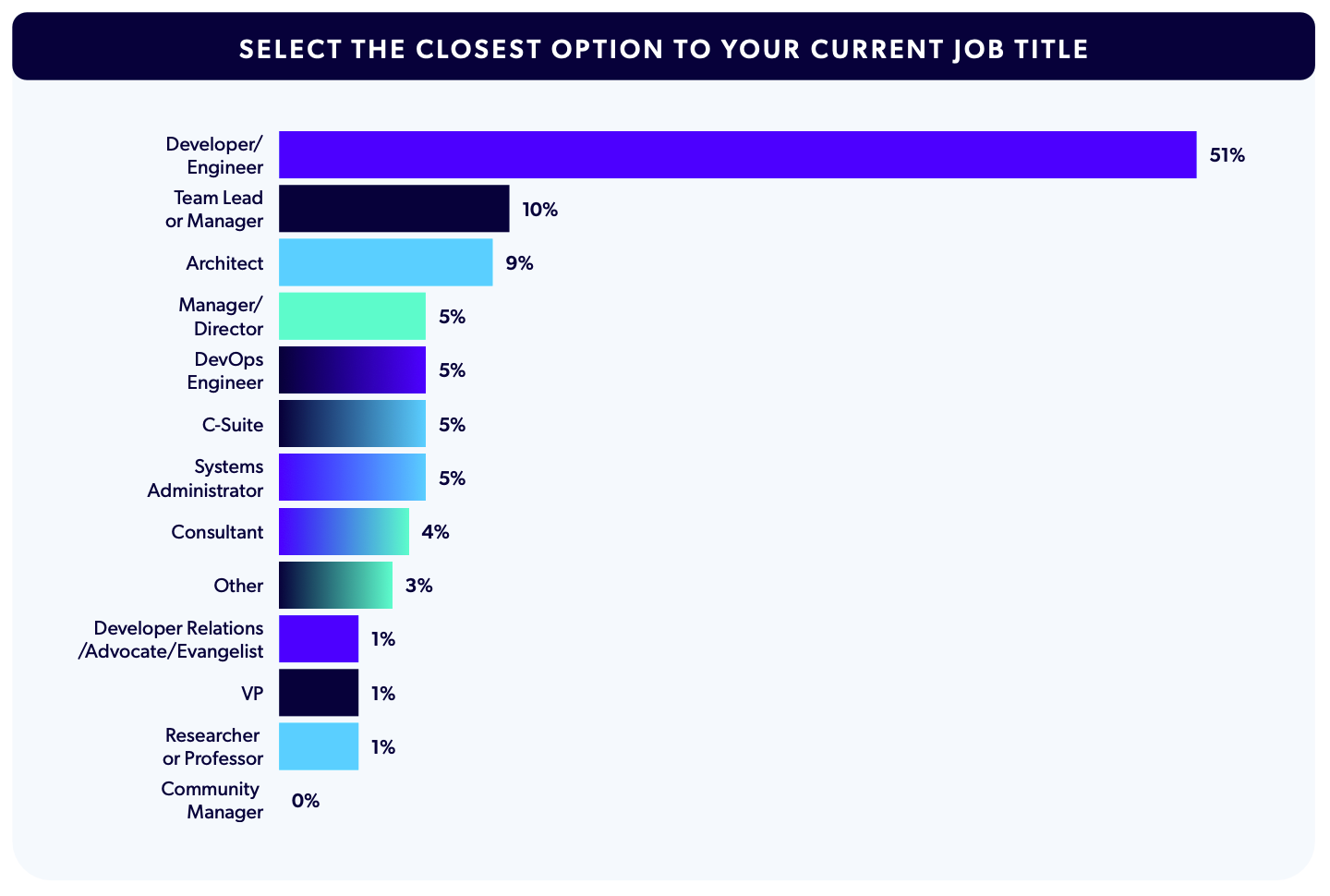
This matches with what I know about PHP users. Our participants are largely developers or engineers, which makes sense, as developers are often the most involved in the day-to-day management and creation of PHP applications.
PHP Experience
We also asked survey takers to share how long they’ve been using PHP. In an echo of our 2025 findings (past report editions available here), over half of the participants have been using PHP for 15 years or more. This was followed by 10 to 15 years (18%) and 5 to 10 years (14%). The remaining 15% have been using PHP for 5 years or less.
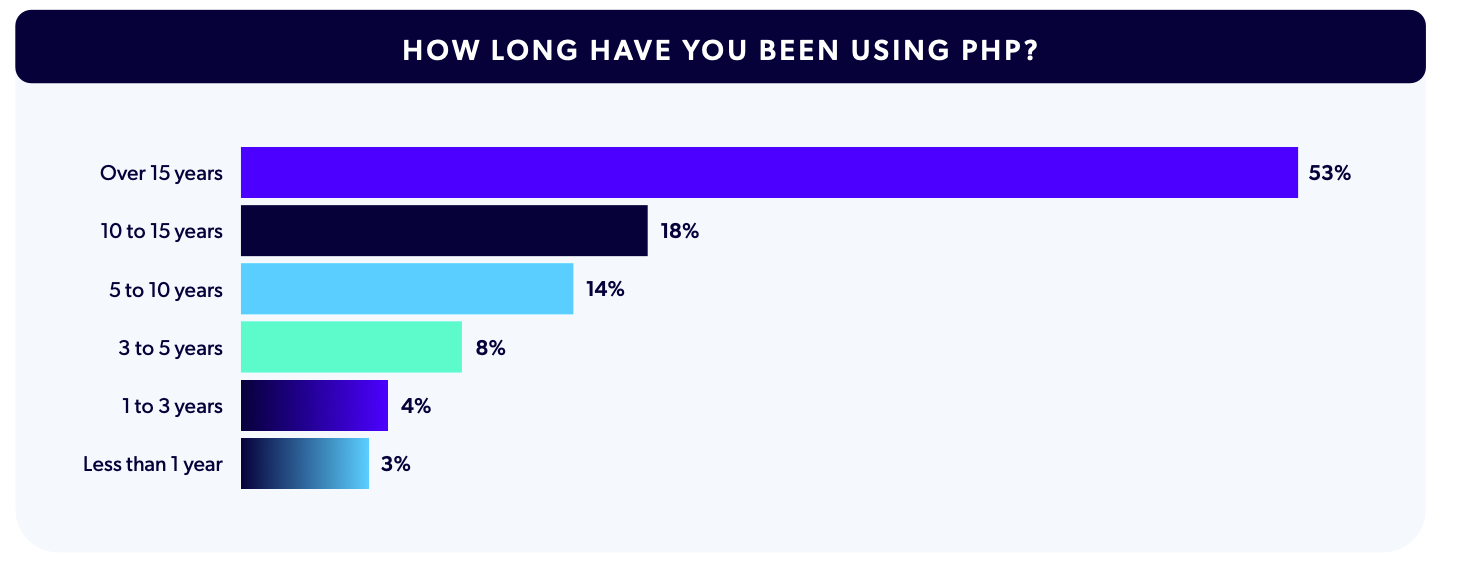
This is the second year we’ve asked about years of PHP experience. As with last year, our survey participants skew more experienced with a large drop off after the 5 – 10 year mark. While this does follow with other surveys and reports in the ecosystem, it is notable.
PHP is a mature language with a long history, and it makes sense that many established professionals will have been using it for a decade or more. But if you or your organization is building or maintaining PHP applications, it is likely a cause for concern — fewer new developers lead to increasing concerns about where to find new hires.
Company and Developer Team Size
Just under half of surveyed PHP users worked for companies with 1 to 20 employees, with over 77% on developer teams with fewer than 10 members. This points to a continuing theme for PHP teams – a small number of developers under pressure to drive new features and maintain legacy systems, often for smaller organizations.
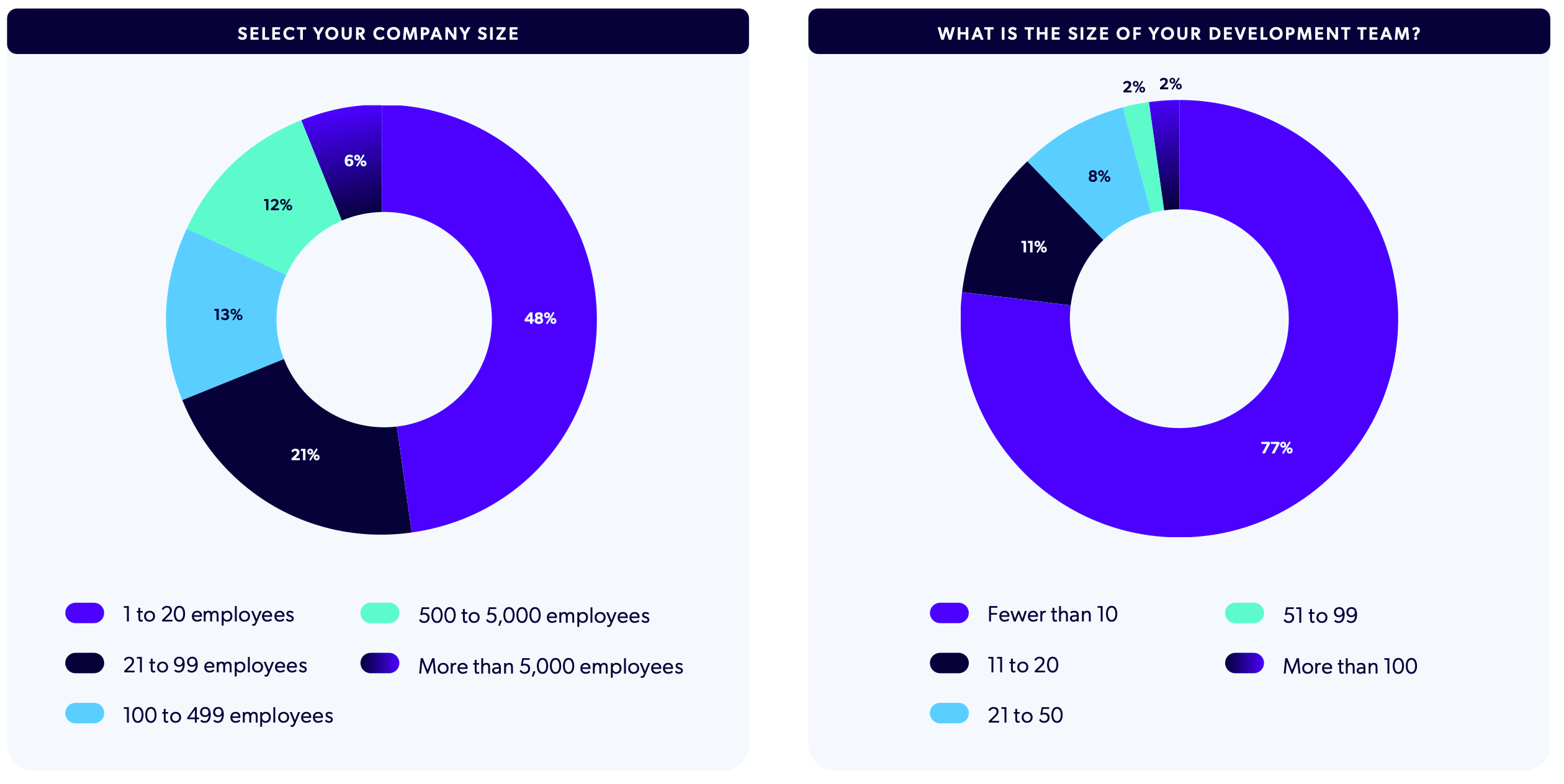
For more information regarding the firmographic details of our participants — including a full list of industries represented and geographic location — be sure to request the full report.
Back to topPHP Usage in 2026: Top Application Types
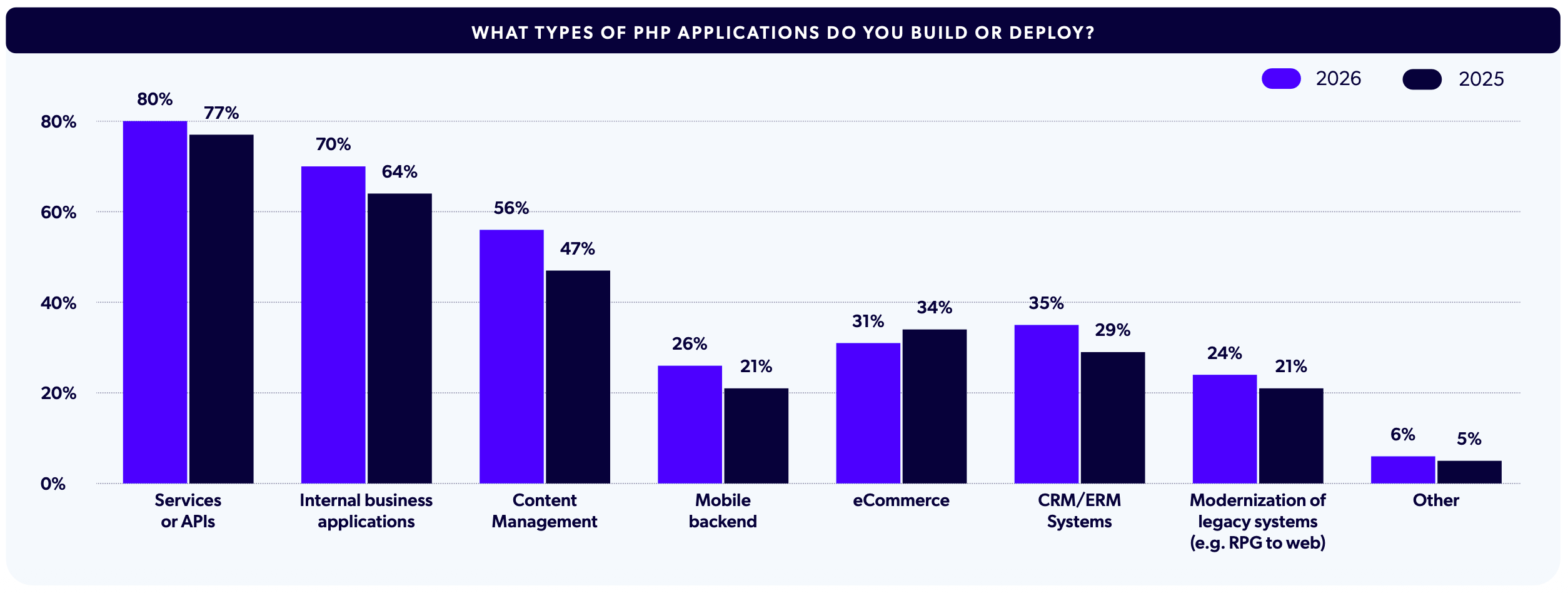
One of the biggest goals of our annual survey is to track new and continuing trends around PHP application development and deployment. To that end, we asked our surveyed PHP users about the types of applications they are building or deploying, including the option to select multiple answers.
As with previous years, Services or APIs was the top type of PHP application (80%), followed by Internal Business Applications (70%) and Content Management (56%). To fully understand our data, we then compared the 2026 results to 2025. While the top types of PHP applications remained consistent year over year, the exact percentages shifted slightly, suggesting that teams are using less out-of-the-box applications such as CMS and e-Commerce, and may be moving to more custom solutions.
Back to top
PHP Trends: Application Integration
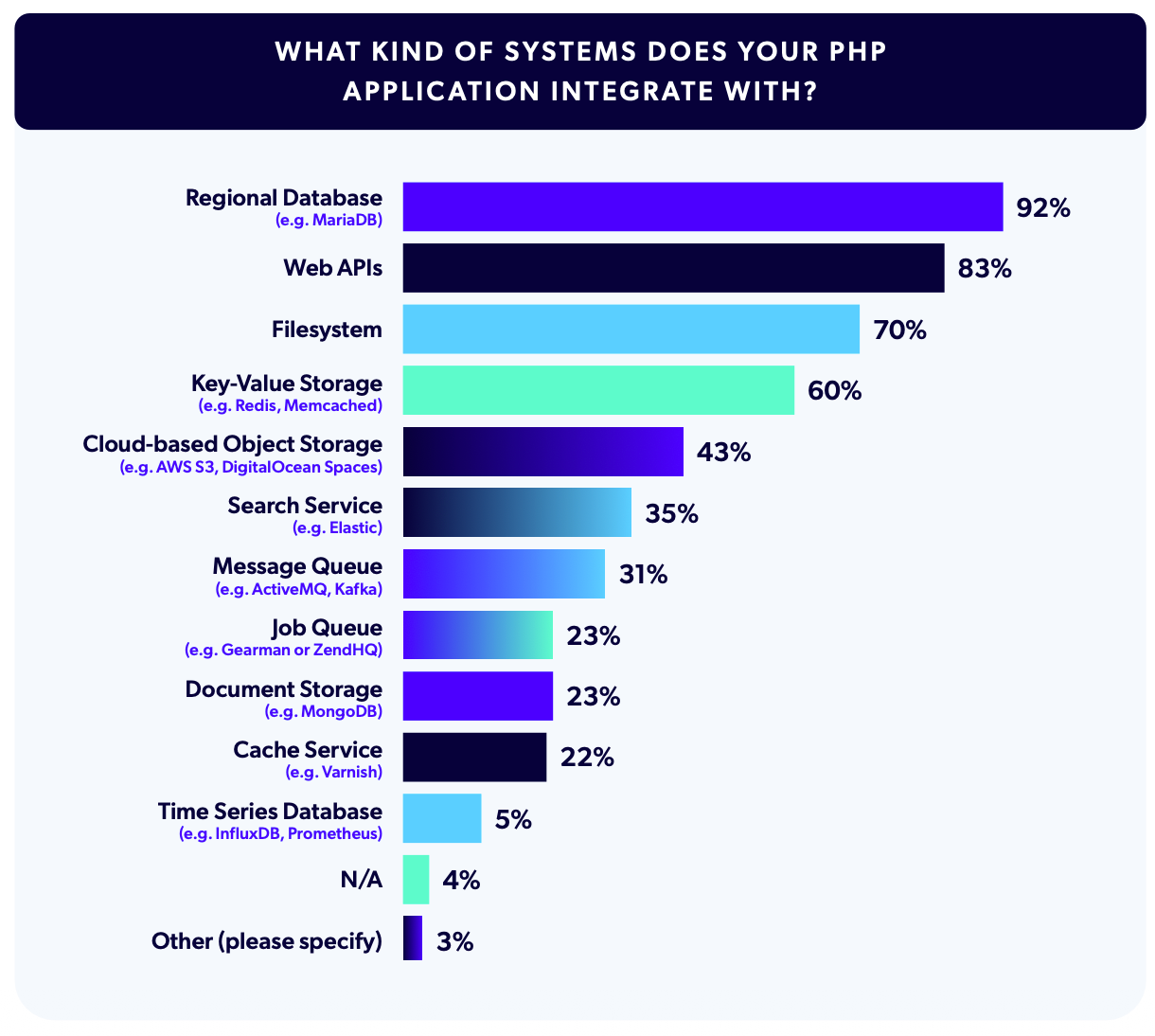
Next, we asked with which kinds of systems participants’ PHP applications were integrated. As PHP is a “glue” language of the web, and most teams integrate with several systems at once, we gave the option to select multiple answers. As with previous years, Relational Databases were the top selection at 92% of applications, followed by Web APIs (83%), Filesystem (70%), and Key-Value Storage (60%).
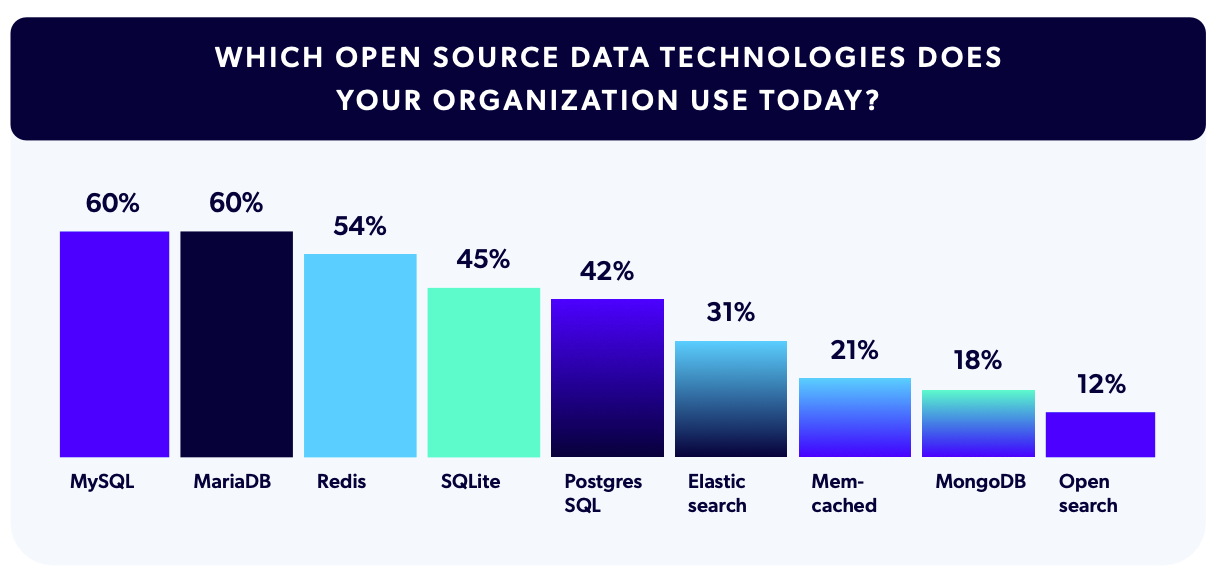
With Relational Databases as the top integration, we also asked which open source data technologies were currently used at participants’ organizations. MySQL and MariaDB tied for the top-used data technology at 60%. However, in Europe and the UK, MariaDB rose to to the top position over MySQL, at 67% vs. 58% of applications.
My colleague, Zend Senior Manager of Sales Engineering Massimiliano Cavicchioli, dives in on what this PHP usage data means:
Back to top“The popularity of MariaDB over other databases in the EU and UK is notable, possibly speaking to Oracle’s ownership of MySQL. Additionally, for how quick PHP was to adopt NoSQL, it’s interesting to see that RDBMS solutions are the top used.
Redis being as high as it speaks to ease of deployment and integration with PHP for session clustering — though the same could be said for Memcached, with the caveat that it is more than half as popular than Redis. The rising popularity of Elasticsearch over the past few years is likewise remarkable, and I think the niche it fills for search and analytics has propelled that growth.”
PHP Application Deployment Trends
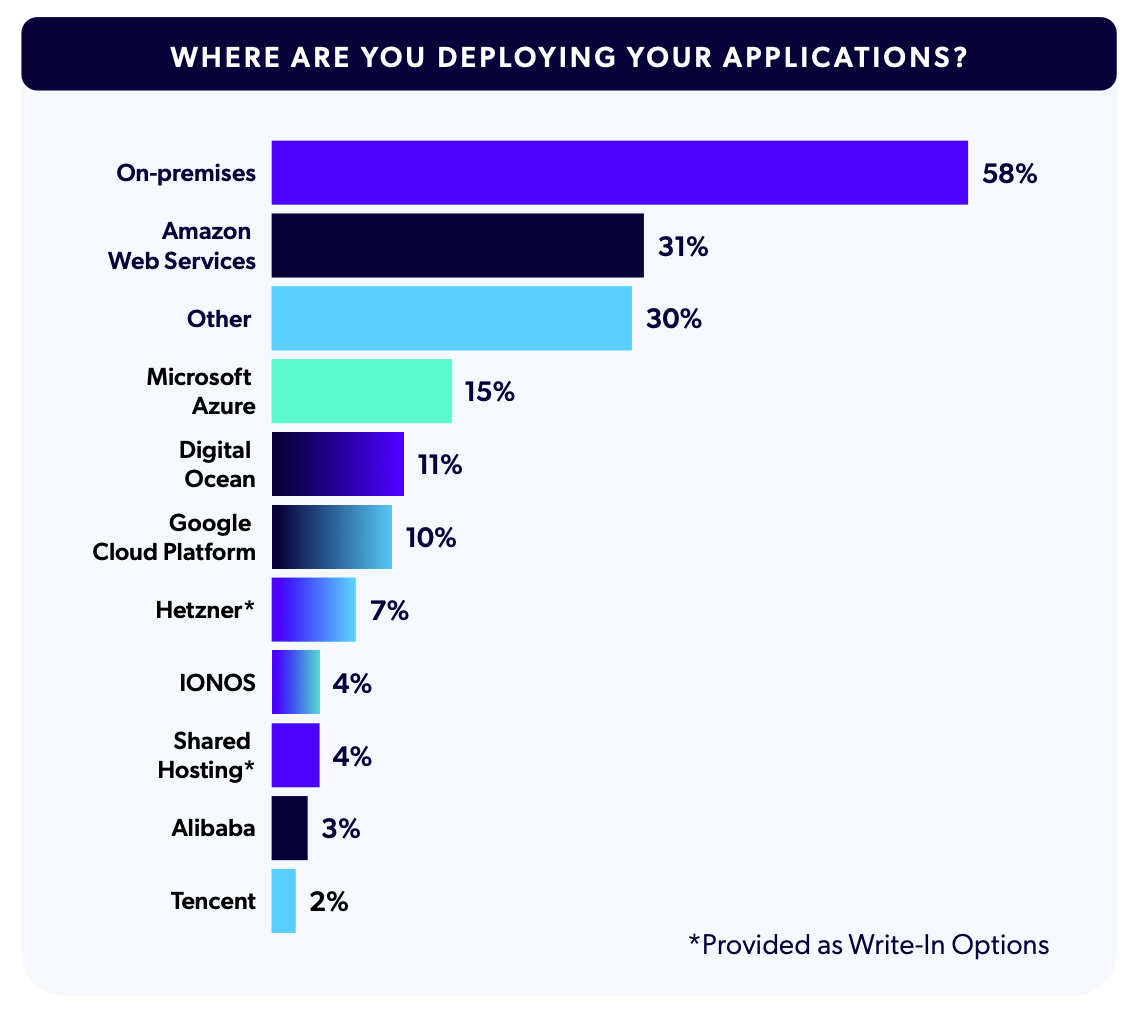
We asked participants to share where they deploy their PHP applications, again with the option to select multiple answers as applicable. 58% of applications were deployed On Premises, followed by 31% on Amazon Web Services, and 30% on Other. Repeated write-in options included Hetzner (7% of all responses), shared hosting (4% of all responses), and various clouds and private servers.
My colleague, Senior Solutions Engineer Yeshua Hall, discusses what this means for the ecosystem:
Back to top“Looking at deployments, teams continue to steadily move toward on-premises environments, with adoption increasing every year. This has been true since 2022, when on-prem first outpaced Amazon Web Services as the top deployment method. To me, this says that many PHP users are prioritizing control, compliance, and long-term cost predictability over a cloud-first approach.
While public cloud platforms still play an important role, their growth has flattened, which seems to point to more deliberate and workload-driven infrastructure decisions. Teams want to manage costs while having complete control over the security of their critical applications and sensitive user data — which is easier to ensure on-premises.”
2026’s Top PHP Operating Systems
We then moved onto operating systems, asking participants to share which OS their organizations use today, with the option to select multiple answers. As with previous years, Ubuntu (61%) and Debian (40%) were named the top choices.
Comparing 2026 results with 2025, it is unsurprising to see CentOS fall in usage, as it has been EOL for over a year. However, we also saw a large jump in Windows usage, rising to 31% of responses in 2026 from 13% in 2025, and we continue to see a rise in Alpine Linux usage, which rose to 31% from 18%.
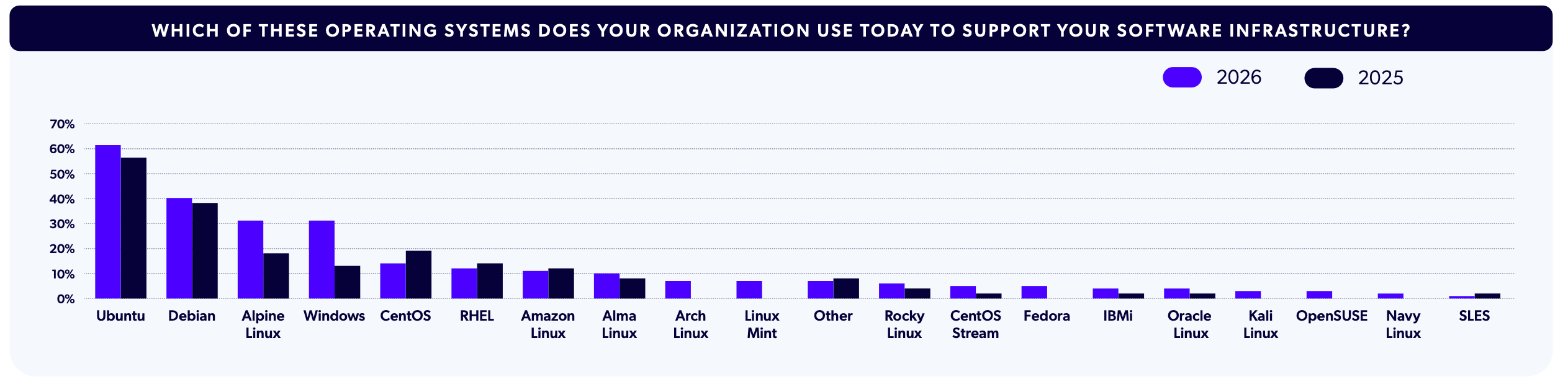
These results show that organizations are running increasingly mixed OS environments, with the high usage of Debian and Ubuntu suggesting Linux remains the default foundation for many stacks. The steep rise in Windows usage is striking, and it could signal an expansion of Windows footprints alongside Linux. Whether this is for specific workloads, tooling, or hybrid operations is not clear from our data.
At the same time, Alpine Linux’s continued growth points to growing container adoption. This is likely because Alpine is widely chosen for lightweight and container-friendly deployments — but we’ll cover containers in a future blog. Keep an eye out in the coming weeks!
Back to topFinal Thoughts
The 2026 PHP Landscape Report underscores the continued relevancy of PHP in web development. While many PHP usage and deployment trends remain consistent year over year, they also reflect the strategic choices made by PHP teams around the world as they respond to financial, operational, and other needs.
In future blogs exploring our 2026 PHP Landscape Report, we'll cover a variety of PHP trends, including adoption and migration plans, security and compliance strategies, how teams are tackling application monitoring, and more. If you're eager to check out the data sooner, click the button below to grab a PDF of our full findings.
Stay Ahead of PHP Trends in 2026
The PHP ecosystem changes fast. Discover ongoing trends, in-depth data, and expert insights on how to gain an edge in 2026.
Additional Resources
- Report – The 2026 State of Open Source Report
- Report – The 2026 PHP Landscape Report
- Guide – Developing Web Applications With PHP
- Blog – PHP 8.5: New Features and Deprecations
- Blog – Is PHP Still Relevant?
- Blog – PHP Installer for Extensions (PIE): What to Know Before General Release