Blog
September 25, 2026
Does PHP Still Fit in Your Web Application Modernization Roadmap?

State of PHP,
PHP Development,
Modernization
Modernization pressure is everywhere, with development teams being asked to improve performance, strengthen security, adopt AI tooling, support cloud-native architectures, and accelerate delivery cycles — often while continuing to maintain mission-critical applications that have been running for years.
As organizations revisit their application modernization roadmap, one question frequently surfaces: should we modernize our existing PHP applications, or is it time to replace them? The answer, like most things, depends on the nuances and specific infrastructure of the exact application in question.
That’s why in this blog, I will examine when leaving PHP for other languages makes sense, why I see many organizations choosing to stay, and how to approach legacy application modernization without creating unnecessary risk.
Back to topThe Case for Replacing Legacy Systems Built on PHP
PHP remains a powerhouse in the open source ecosystem, with an estimated 70% of web apps using the language. Yet, despite its prevalence, there are situations where moving away from PHP could be the right decision. More than that, it’s a conversation that my team at Zend has with many of our customers. Is PHP still the right fit for your critical systems?
When Is Leaving PHP the Right Call for Your Application Modernization Roadmap?
Most modernization initiatives should start with a simple question: What problem are we trying to solve?
If the answer is poor maintainability, security concerns, technical debt, or outdated infrastructure, you may not need to abandon PHP. Many of these challenges stem from aging architectures, unsupported runtimes, learning curves, or neglected codebases, not the language itself.
However, there are situations where migrating away from PHP deserves serious consideration:
- The application requires capabilities better suited for another technology stack
- The business is consolidating platforms following acquisitions or mergers
- Internal development expertise has shifted entirely toward another language ecosystem
- The application must integrate with organizational tooling that heavily favors a different platform
- A complete rebuild is already required due to extensive technical and architectural constraints
In these situations, migration may support broader business goals. The important distinction is that the business case should drive the decision, not assumptions about PHP's relevancy.
What Does Migration Away From PHP Look Like?
I often work with teams having migration discussions that sound straightforward in planning meetings but, in reality, turn out to be far more demanding. Many organizations are happy to talk about rebuilding applications in another language or replacing legacy systems entirely, but they fail to accurately estimate the time and resources the project actually requires, making it appear attractive. And in some cases, even with a complete rewrite, PHP is still the best choice.
For instance, a migration away from PHP typically involves:
- Rewriting or replacing large portions of application code
- Rebuilding integrations
- Retesting business logic
- Retraining development teams
- Validating security and compliance requirements
- Coordinating deployments and cutovers
- Managing parallel systems throughout transition periods
These complexities, along with the many features and benefits PHP offers, are why the number of organizations leaving PHP remains surprisingly small. In fact, according to the 2026 PHP Landscape Report, only about 3% of surveyed organizations planned to retire their PHP applications in 2026.
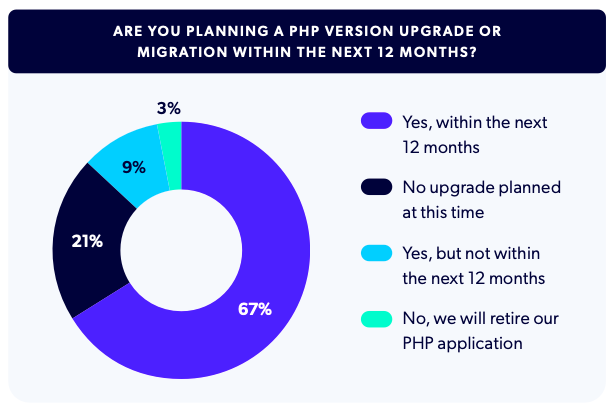
That matches field observations by the Professional Services team at Zend. Once leadership evaluates costs, timelines, business disruption, and project risk, many discover that modernizing an existing PHP application provides a stronger return on investment than starting over with an entirely new technology.
Back to topIs PHP Still Relevant?
Of course, continued investment in a declining language shouldn’t be a part of any web application modernization roadmap — but PHP is not declining. In reality, PHP is still relevant and shows no signs of going anywhere.
The perception that PHP is outdated often comes from experiences with much older versions, or where technical debt was allowed to build up. Modern PHP looks very different than PHP from a decade ago. The question is no longer whether PHP can support modernization, but whether organizations are taking advantage of what current PHP versions already offer.
Recent Improvements in PHP 8.X Versions
The biggest advantage of PHP 8.X versions is the ability to modernize existing applications without starting over.
Current PHP releases help teams improve maintainability, strengthen security, reduce technical debt, and support modern deployment practices while preserving existing business logic and investments. This in turn allows organizations to extend application lifespan, lower modernization costs, and reduce the risks typically associated with replacing legacy systems.
Adoption data suggests organizations recognize these benefits. PHP 8.X versions now account for about 78% of applications reported in the 2026 PHP Landscape Report, while 68% of teams migrated to a newer PHP version in the past 12 months.
What I tend to see is that organizations running older versions find that upgrading delivers meaningful modernization gains without requiring major application rewrites. So, if your team is considering a move away from PHP, it may be worth evaluating if an upgrade within PHP may make more sense for your immediate web application modernization roadmap — particularly if deploying EOL PHP versions. It will deliver performance improvements and better usability for a fraction of the cost of migrating to an entirely new technology.
Free Code Assessment
Get a Free Review of In-Scope Code and Dependencies
Planning a PHP migration can be complex, especially when you don’t know what risks may be hiding in your code. Start your next PHP upgrade off strong with a complimentary code assessment from Zend experts.
PHP's Staying Power in the OSS Ecosystem
A web application doesn’t exist in a vacuum, and before replacing legacy systems built on PHP, it’s good to take a moment to zoom out and look at where the language fits within the wider open source software (OSS) ecosystem.
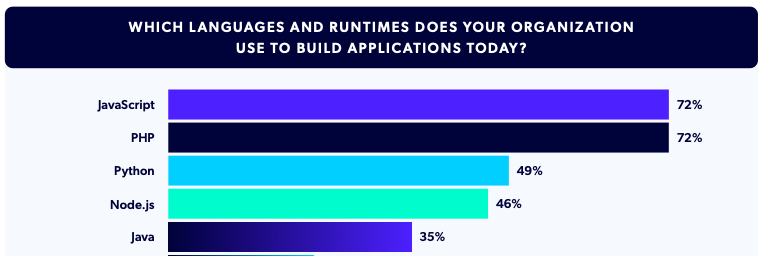
Returning to data collected in the 2026 PHP Landscape Report and shown in the chart above, PHP tied with JavaScript as the most widely used open source language among surveyed users. Additionally, 99% of PHP teams reported maintaining or increasing their use of open source technologies over the past year.
The report also found that:
- 80% of respondents use PHP for services and APIs
- 70% use PHP for internal business applications
- PHP applications commonly integrate with databases, APIs, containers, and cloud platforms
In other words, PHP is not surviving on legacy workloads alone. It continues to play an active role in modern software ecosystems.
On-Demand Webinar
Managing Mission-Critical Web App Migrations
Join Zend Senior Professional Services Engineer Clark Everetts for an in-depth webinar on how to manage successful PHP web app migrations, including planning considerations, elements that will impact your strategy, and how to take on common PHP migration challenges.
Building a Web Application Modernization Roadmap: Stay on PHP or Go?
One of the most important decisions in any application modernization roadmap is determining whether to modernize an existing platform or migrate to a different one. Many organizations assume replacing legacy systems is the natural next step, but a successful modernization strategy should be driven by business outcomes, costs, risks, available expertise, and long-term objectives.
Before committing to a migration effort, evaluate the value your PHP applications provide today, and the investment required to achieve your desired future state. The table below outlines common scenarios where remaining on PHP may be the most practical option, as well as situations where migration deserves consideration.
There is no right or wrong answer here. The best option will vary widely not only between organizations but also between web applications. Always keep modernization focused on business outcomes.
| Stay With PHP If... | Consider Migrating Off PHP If... |
|---|---|
| The web application still delivers business value | The web application requires a complete architectural replacement |
| Your team already possesses PHP expertise | PHP expertise no longer or does not exist internally |
| Core functionality remains stable | Business requirements demand capabilities unavailable in your current stack |
| Upgrades to modern PHP versions are feasible | Rebuilding is already planned for other strategic reasons |
| Modern frameworks (such as Laravel, Symfony, or others) can address maintainability concerns | Platform consolidation requires standardization to another language |
| Cost and risk reduction are high priorities | Long-term business goals clearly support migration |
| Technical debt is manageable through refactoring | Technical limitations make continued investment impractical or impossible |
Modernizing Within PHP
Keep in mind that modernization doesn't necessarily require replacing legacy systems entirely or moving to a new language. It can also mean improving your existing web application: addressing architecture issues, reducing technical debt, strengthening security, and adopting more modern development practices. In short, it can mean modernizing within existing PHP web applications.
But what does this look like in practice?
Modernization is an Ongoing Process, Not a Single Event
As PHP and other technologies evolve, security requirements change, and customer expectations rise, applications must keep adapting. This turns modernization from a one-time heroic effort into a series of ongoing projects and tasks.
Organizations that embrace continuous improvement typically face less risk than those that wait years between major transformation changes. Small, ongoing investments are often easier to manage than large-scale modernization projects undertaken under pressure.
Here are a few examples of how this could look in day-to-day workflows:
- Keeping PHP runtimes current
- Practicing strong PHP dependency management
- Refactoring high-risk or high-maintenance code
- Improving testing and deployment processes
- Strengthening security controls
- Reducing technical debt incrementally
- Adopting modern architectural patterns where appropriate
Using AI-Accelerated Methods for Legacy PHP Application Modernization
AI has rapidly changed how we approach web application modernization. Activities that once required extensive manual effort can now be completed faster and more consistently, allowing development teams to focus more time on strategic work.
For legacy PHP applications, AI can help identify technical debt, generate tests, accelerate documentation, analyze dependencies, and suggest code improvements. These capabilities can reduce the amount of effort required to evaluate and modernize large or complex applications.
However, AI works best as an accelerator, not a replacement for developer expertise. Modernization still requires an understanding of business requirements, application architecture, operational constraints, and organizational goals. The most successful teams combine AI-assisted tools with experienced developers who can evaluate recommendations, prioritize improvements, and ensure modernization efforts align with long-term business objectives.
AI-Accelerated PHP Modernization
How to Make the Most of AI Tools for Modernization
AI tools can significantly speed up modernization projects, but only when paired with expert oversight. Learn more in this video.
In-House vs. Third-Party: What Legacy Application Modernization Actually Requires
Whether you stay on PHP or migrate elsewhere, successful modernization requires far more than updating code. They demand time, expertise, and careful coordination across stakeholders.
Organizations with experienced PHP teams may choose to manage modernization internally. Internal developers bring valuable knowledge of application history, business processes, and operational requirements. That familiarity helps teams make informed decisions and stay aligned with organizational goals.
At the same time, modernization projects often introduce challenges that internal teams encounter only occasionally. Third-party specialists, such as Zend Professional Services, bring experience from a wide range of upgrade, migration, and modernization initiatives. Their exposure to common pitfalls, proven methodologies, and modernization best practices can help accelerate projects and reduce risk.
| Benefits of In-House Developers | Benefits of Third-Party Partners |
|---|---|
| Deep knowledge of business requirements | Experience across many modernization projects |
| Familiarity with web application history | Proven modernization frameworks and processes |
| Direct access to stakeholders | Faster project execution |
| Established operational workflows | Specialized expertise in upgrades and migrations |
| Long-term ownership of the web application | Additional resources without expanding headcount |
| Alignment with organizational priorities | Independent technical assessment and guidance |
Back to top
Final Thoughts
The right web application modernization roadmap starts with understanding your application's current state, identifying the highest-impact improvements, and prioritizing investments that align with business goals.
For some teams, that may involve migrating platforms. For many others, modernizing within PHP offers a practical, cost-effective path forward. After all, modernizing PHP applications doesn’t require a full rebuild to deliver meaningful results. I find that many organizations can strengthen security, improve maintainability, reduce technical debt, and support future growth by modernizing the applications they already have.
PHP Support and Services
Make Our PHP Experts Your Experts
If you're evaluating your options, Zend Professional Services can help assess your applications, uncover modernization opportunities, and build a roadmap tailored to your technical and business requirements.
Additional Resources
- On-Demand Webinar - The Hidden Costs of Enterprise Web App Modernization
- Case Study - Bark.com Saves 20+ Weeks of Engineering Work on PHP Modernization Project
- Case Study - Healthcare Tech Provider Modernizes PHP While Preserving Business Focus
- Blog - PHP Migration and Version Adoption Trends
- Blog - Updating PHP for More Secure Web Apps