
Blog
July 24, 2026
Docker Compose vs. Kubernetes: What's the Best PHP Orchestration Tool?


Security,
PHP Development,
Performance
Every PHP team that containerizes an application eventually hits the same fork in the road. You have a working set of containers, and now you need to run and deploy them reliably. Two popular options are Docker Compose and Kubernetes, and your choice between them will shape how your PHP application scales, recovers from failure, and moves between environments.
In this post, we compare Docker Compose vs. Kubernetes. We cover what each tool is, where they overlap, and where they diverge. We also cover how they relate to the 12-factor web app methodology, and we ultimately provide insight into how to pick the right tool for your PHP app deployment.
Back to topDocker Compose vs. Kubernetes: Overview
At its core, the difference between Docker Compose and Kubernetes comes down to scope. Compose runs multi-container applications on a single host. Kubernetes coordinates containers across a cluster, handling scaling, healing, and networking automatically.
Both tools start from the same place: a containerized PHP application. Where they part ways is the level of automation and resilience they provide once that application needs to run in production.
Docker Compose vs. Kubernetes: Quick Comparison
| Category | Docker Compose | Kubernetes |
|---|---|---|
| Primary Use Case | Defining and running multi-container applications, often for local development, testing, CI, or simpler deployments | Managing containerized workloads and services across clusters, especially for production environments that need automation, scaling, and resilience |
| Configuration Model | Uses a Compose YAML file to define services, networks, and volumes | Uses declarative resources such as Pods, Deployments, Services, ConfigMaps, and Secrets |
| Learning Curve | Lower — teams can define an application stack and start services with a single command | Higher — teams need to understand clusters, workloads, services, networking, storage, configuration, and operations |
| Scaling | Useful for smaller workloads and simple service scaling | Built for deployment, scaling, and management of containerized applications |
| Resilience | Provides basic container lifecycle management | Provides self-healing, failover, automated rollouts, rollbacks, service discovery, and load balancing |
| Portability | Good portability across environments that support Docker Compose | Strong portability across cloud, hybrid, and on-premises environments |
| Operational Complexity | Lower operational overhead | Higher operational overhead unless using a managed Kubernetes service or platform |
What Is Docker Compose?
Docker Compose is a tool for defining and running multi-container applications on a single host using a declarative YAML file. You describe your services, networks, and volumes in one or more YAML files (generally docker-compose.yml, but now often compose.yaml), and Compose brings the whole stack up with a single command.
The architecture is deliberately simple. All services run as containers on one Docker Engine, connected through internal networks and backed by named volumes for persistent data. A typical PHP stack maps cleanly onto this model:
The architecture is deliberately simple. All services run as containers on one Docker Engine, connected through internal networks and backed by named volumes for persistent data. A typical PHP stack maps cleanly onto this model:
- PHP-FPM for processing requests
- Nginx or Apache as the web server
- MySQL or PostgreSQL for data
- Redis for caching or sessions
Additionally, Docker Compose shines in specific scenarios for PHP app deployment:
- Local development environments that mirror production dependencies
- Staging and demo setups that need to spin up fast
- CI pipelines that create ephemeral service dependencies for automated tests
- Single-server production for low-traffic PHP applications
The result is a fast, reproducible environment with minimal overhead. That simplicity, coupled with guaranteed idempotency, is the whole point.
What Is Kubernetes?
Kubernetes is an open-source container orchestration platform that automates deployment, scaling, and operations of containerized applications across a cluster of machines. Instead of running everything on one host, Kubernetes continuously reconciles the actual state of your system against the desired state you declare. You define workloads through manifests, and tools like Helm charts package those workloads for repeatable deployment.
The architecture has two layers. The control plane includes the API server, scheduler, controller manager, and etcd, which together decide what runs where. The worker nodes run the kubelet, a container runtime, and kube-proxy to execute those decisions. Your PHP application lives inside core objects:
- Pods running your PHP-FPM containers
- Deployments managing replicas and rollouts
- Services for internal routing
- ConfigMaps and Secrets for configuration
- Ingress for external traffic
Furthermore, Kubernetes earns its complexity in demanding environments:
- High-traffic, mission-critical PHP applications that need automatic scaling
- Multi-region or multi-cloud deployments where portability matters
- Teams pursuing cloud-agnostic deployment to reduce vendor lock-in
- Self-healing workloads with rolling updates and zero-downtime releases
If Compose is about running containers well on one machine, Kubernetes is about running them well everywhere, supported by a plethora of architecture design patterns necessary for mission-critical workloads.
PHP Landscape Report
Docker and Kubernetes are the Top Container Technologies of 2026
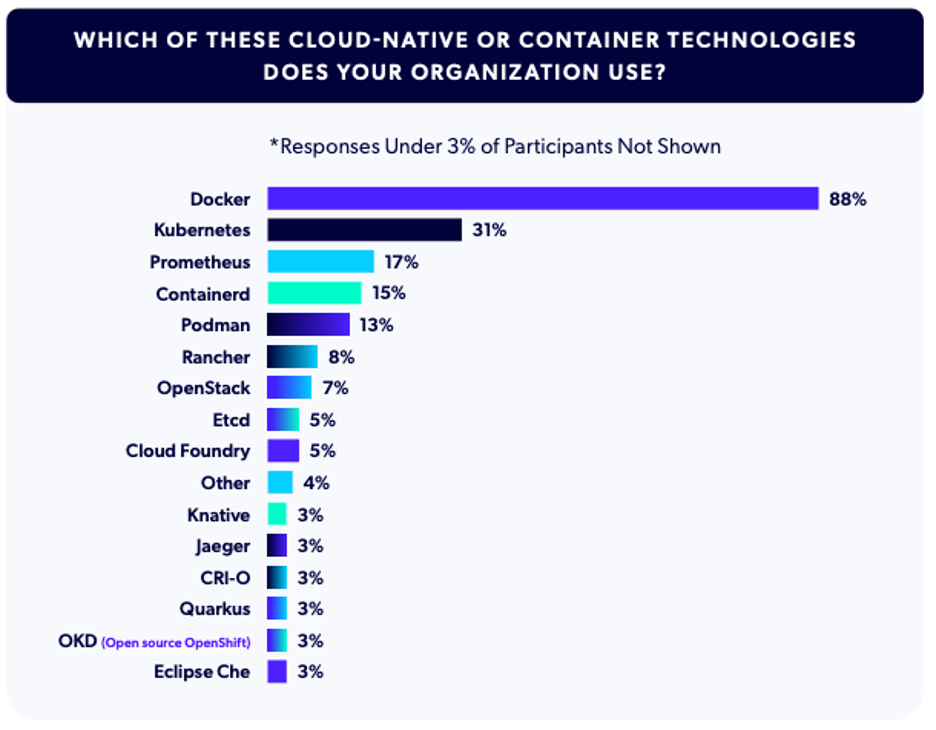
According to the PHP Landscape Report, 88% of surveyed PHP professionals deploy using Docker, and 31% deploy using Kubernetes. Get your free copy of the full report to explore our complete findings alongside expert analysis.
What Do Docker Compose and Kubernetes Have in Common?
Despite operating at different scales, both Docker Compose and Kubernetes share the same containerization foundation and a declarative philosophy, which is why moving from Docker Compose to Kubernetes is a realistic path versus a full rewrite!
Docker Compose and Kubernetes both define desired state in YAML, which keeps your infrastructure versioned alongside application code. They each also provide internal networking between services and persistent storage for databases and shared assets, inject configuration and secrets at runtime, and will help your PHP app deployment align with the current ecosystem.
Back to topWhat Is the Difference Between Docker Compose and Kubernetes?
Of course, when comparing Docker Compose vs. Kubernetes, the differences are often the more pressing concern. From scale to complexity to cost, let's take a look at where these two technologies diverge for PHP web applications.
Docker Compose vs. Kubernetes: Scale
The main difference concerns application scaling Docker Compose can scale services, but is limited to the resources of the machine on which it runs, while Kubernetes is built for multi-node, automatic scaling across a cluster of servers.
Docker Compose allows you to define replicated service deployment, and to define the number of replicas to run in parallel. However, these all run on the same host, which means your host can run out of resources and fail. The number of replicas is fixed; Compose will not add or remove containers based on traffic. It also will not perform any form of advanced load distribution; Compose essentially performs round-robin DNS balancing, and does not take into account the health of a given container.In short, it is only applicable when scaling needs are small and predictable.
Kubernetes, on the other hand, can spread containers across multiple machines and reschedule them if a node fails. It supports automatic scaling based on container health, CPU load, memory usage, or a variety of other factors. It’s not just limited to spinning containers up and down, either; it provides advanced deployment patterns like rolling updates and canary releases. Kubernetes is designed for workloads that need reliability under changing traffic, not just more container copies.
Docker Compose vs. Kubernetes: Complexity and Learning Curve
Generally speaking, Docker Compose is much easier to learn and use, while Kubernetes has a steeper learning curve. This is because Kubernetes introduces more concepts, more configuration, and more operational overhead.
Applications deploying Docker Compose can often be described in a single YAML file with a minimum number of declarations; sane defaults are used for networking and storage, allowing users to focus on declaring the services used, and the ports they expose to each other. It is fantastic for learning the basics of containerized, distributed applications without needing to deepen on concepts like clustering, scaling and resilience.
Additionally, when things go wrong, because you're mostly dealing with one machine and a limited number of moving parts, you'll find it easier to debug and troubleshoot.
Kubernetes, meanwhile, is a fully infrastructure-as-code (IaC) solution, and the expectation is that you will define everything in granular detail:
- The containers you will use, and whether or not several containers are grouped together ("pods")
- Whether or not any containers or pods share storage with each other, and if that storage persists between deployments
- How many of these pods to deploy ("ReplicaSets")
- How the ReplicaSets are exposed internally ("Services")
- How to roll out changes to pods (e.g., should k8s pull down the existing pods first and then roll out the new ones, or start the new ones and wait for them to be healthy before switching over to them)
- Which services can communicate with each other
- How the services are reached externally ("Ingress")
- And more!
Much of this complexity exists to facilitate coordination within a clustered environment. While it is YAML all the way down, like Docker Compose, there are too many resources, and ways those resources interact, to describe. This can lead to hard to detect or understand failures, but gives you the benefit of flexible, production-grade orchestration that adheres to well-known and battle-tested orchestration design patterns.
As a practical takeaway, Kubernetes is worth learning only when you need production scaling, resilience, and cluster management; the effort it takes to learn it and become productive with it is orders of magnitude more than learning Docker Compose.
Docker Compose vs. Kubernetes: Orchestration and Resilience
For production-grade deployments, you need the ability to define a desired deployment state, and trust that the tooling will ensure that state is not only reached, but that it anything in the state changes — e.g., a service fails — it will take care of it without intervention, Like scaling, this is an area with a clear winner: Kubernetes.
Docker Compose does allow you to specify the desired deployment state: you can define services, storage, networks, and more. When bringing the deployment up, Compose will either reach the desired state, or raise errors indicating the issues.
Compose includes a number of facilities to ensure limited resiliency, but they require extra effort and understanding to implement correctly. For example, it supports restart policies, but these are limited to restarting whenever the container stops, or based on failure status. It has no idea what to do if it continually fails, particularly if the failure is due to resource exhaustion.
And, as noted previously, Compose is limited to a single machine; you cannot coordinate across multiple machines to provide resiliency and failover. It can orchestrate the services it encompasses, but only within the limits of that machine. If the machine or deployment fails, you need to intervene; Compose will not resolve things for you.
Which brings us back to Kubernetes.
While the configuration of Kubernetes can be daunting to learn, it gives complete control over orchestration, including what to do when services fail — and what actually constitutes failure. Moreover, you can define how to handle changes to the system, making it possible to deploy updates to a single pod, ReplicaSet, or service without disrupting other aspects of the application deployment (such as the database, caching server, search service, etc.). Further, you can define how updates are rolled out — or rolled back — to either ensure correctness or availability, or a mixture of the two.
Due to the fact that Kubernetes operates as a distributed cluster, it can identify failures in individual nodes, and redeploy pods and services to known-healthy nodes without disrupting access to the application. If a node is hitting resource limits, it can distribute containers to other nodes to ensure available capacity. Even better: you can distribute your cluster over multiple networks, clouds, and geographic regions. Kubernetes will handle coordination of resources for you.
Docker Compose vs. Kubernetes: Cost
A factor with any orchestration platform is cost. What will be the total expense to your business to run the platform? But this is not a simple equation, and you must consider:
- The costs of downtime, including lost business, reputational damage, etc.
- The personnel costs to monitor and remediate platform issues
- Regulatory cost, including penalties for downtime or insecure deployments
The beauty of Docker Compose is that it runs anywhere Docker runs, and it is only constrained by the resources of the host machine. This means that your developers can likely run your entire application platform on their workstation without issues — or that you can fire up an entire application for end-to-end testing in your CI/CD pipeline.
As such, getting started with it is a minimal investment, and for low-traffic websites where resilience and scaling are not important, it provides a portable deployment paradigm. Fire up a virtual machine in a cloud provider, install Docker and Docker Compose, and you’re ready to go.
However, you’ll need staff to monitor the site and be on hand to resolve issues if it goes down, as the platform does not offer self-healing or failover. Additionally, you’ll need to ensure you have a backup/recovery plan in case the instance goes down — any data you’re persisting in named volumes, any container images you’re building locally, all of this will need attention. These are all trade-off costs you’ll need to weigh.
The requirements for Kubernetes vary based on the Kubernetes runtime environment you choose.
Unlike Compose, there are multiple options, ranging from the official Kubernetes distribution to alternatives such as OpenShift, Rancher Kubernetes Engine (RKE), minikube, k3s, or MicroK8s. Most managed clouds offer their own distributions as well: EKS on AWS, AKS on Azure, and GKE on Google Cloud, as well as options from smaller providers such as DigitalOcean or OVH. Each has its own costs, and you’d be wise to map out your exact needs and research the capabilities and cost structure of each to find a match for your business.
Once you have defined your Kubernetes deployment, however, you have a portable solution you can take to any of these distributions or clouds. If costs change at one, you can pick up and go to another. Additionally, with the scaling and resilience factors you build in, you can help tailor the overall resource usage to meet your cost requirements, and also prevent unwanted downtime, saving you money in the long run.
Back to top12-Factor App Methodology and PHP App Deployment
The 12-factor app methodology covers practices such as storing config in the environment, treating backing services as attached resources, running the app as stateless processes, and keeping development and production as similar as possible. For PHP teams, these principles reduce surprises during scaling and deployment, and they make maintenance predictable.
Both Docker Compose and Kubernetes address the 12-factor app methodology, and many of their fundamentals are directly influenced by them:
- Storing config in environment variables
- Treating resources as backing services exported via network ports
- Treating applications as stateless, shared-nothing processes (this is what containers were built for!); concurrency via horizontal scaling; disposability of processes, and more.
When comparing Docker Compose vs. Kubernetes, both tools support these factors, but to different degrees. That gap matters as your PHP application grows.
On-Demand Webinar
Thing Big, Start Small: A Phased Approach to 12-Factor Web Applications
Get tips and strategies for how to break 12-factor adoption into manageable, bite-size pieces — including insight on when to use Docker Compose vs. Kubernetes.
How Docker Compose Supports 12-Factor Methodology
The key area where Docker Compose falls short is when it comes to concurrency. As noted in earlier sections, if you need scale, Compose is the wrong tool, as it’s designed to run on a single node. This gives you some simplicity in defining your application, but the cost is exactly that: scale.
How Kubernetes Supports 12-Factor Methodology
Kubernetes gives you the full 12-factors, and more flexibility than Compose in how some of them operate. As some examples:
- Kubernetes not only treats persistent storage as a service, but requires you to define it as such. This decouples storage from the individual nodes and machines, and gives you true portability.
- Special resources such as DaemonSets allow you to gather information such as logging data or telemetry from services, which can give you the tools to monitor and tune your deployment.
- Secrets storage can be defined at the engine level, and help prevent leaking secrets into the wrong environments, providing better security.
- With Kubernetes jobs and concepts like initContainers, you can automate admin and management tasks across the entire cluster.
Scale may often be a deciding factor for moving from Docker Compose to Kubernetes, but these other features, and the control they provide your DevOps team, are often key decision points as well.
Docker Compose vs. Kubernetes: Which Tool Aligns More Closely With 12-Factor Methodology?
Docker Compose covers the foundational factors well for smaller footprints. Kubernetes fully realizes the factors tied to concurrency, disposability, and scale, which makes it the stronger fit for production PHP app deployment at volume.
Choose based on where your application sits on that spectrum today. In practice, this should not be seen as an either-or decision. Docker Compose can help PHP teams implement 12-factor principles earlier in the development cycle, while Kubernetes can extend those principles into production.
Back to topDocker Compose vs. Kubernetes: How to Choose the Right PHP App Deployment Tool
With all of this in mind, when deciding between Docker Compose vs. Kubernetes, your best choice depends on your team's scale, operational maturity, and portability goals rather than on which tool is objectively "better." Both are excellent within their intended range.
That being said, you can use these questions to help evaluate which tool is a better fit for your PHP app deployment:
- How critical is the application? If downtime creates business risk, Kubernetes may be worth the investment.
- How much traffic does the application receive? Higher and more variable traffic often points toward Kubernetes.
- How complex is the application stack? A simple PHP app may not need Kubernetes, while a distributed system may benefit from it.
- How mature is the team’s DevOps practice? Kubernetes works best with clear ownership, automation, and operational standards.
- Does the organization already support Kubernetes? Existing platform support can reduce the cost and complexity of adoption.
- Are you modernizing a legacy PHP application? Docker Compose may be the right first step before moving toward Kubernetes.
Final Thoughts
The choice between Docker Compose vs. Kubernetes is ultimately a choice between simplicity and scale. Docker Compose offers an accessible, low-overhead path to containerization, making it ideal for development environments, smaller deployments, and teams beginning their modernization journey. Kubernetes introduces the automation, resilience, and scalability required for mission-critical applications operating at enterprise scale.
For many PHP organizations, the real challenge is not choosing one tool over the other, but finding the right solution to support their needs today while providing a path for future growth. The Zend Web Platform helps bridge that gap, offering containerized, production-ready PHP environments with built-in observability, portability, and expert support. Whether you're standardizing deployments with Docker Compose or orchestrating workloads with Kubernetes, the Zend Web Platform provides a streamlined foundation for modern PHP application delivery.
Free Demo
See how the Zend Web Platform Fits Within Your Infrastructure
The Zend Web Platform is a custom-configured command center built to simplify PHP management, from single applications using Docker Compose to complex Kubernetes-based environments. Check out this video to get to know its capabilities, then contact Zend to schedule your custom demo.
Additional Resources
- On-Demand Webinar - The Peaks and Valleys of PHP Containerization and Orchestration
- Guide - How to Develop Web Applications with PHP
- Blog - Guide to Enterprise Web App Development
- Blog – PHP Web Application Hardening With CIS Hardened Docker Images
- Blog – Using a GitOps Model for Web Application Development