Blog
June 18, 2026
How to Close the Drupal Maintenance Gap in Government Web Services

PHP Development,
State of PHP
Government web services have relied on Drupal for more than a decade, but many of those environments haven’t kept pace with modern Drupal maintenance and support requirements. As a result, aging Drupal versions, growing technical debt, manual processes, and inconsistent patching have created a widening maintenance gap. For teams responsible for government web services, this increases security risk, complicates compliance, and makes it harder to deliver reliable, high-performing experiences.
In this blog, I break down what the Drupal maintenance gap looks like in practice and why it has become a pressing issue. I outline the core requirements for effective Drupal maintenance and support, then provide a practical, step-by-step approach to stabilizing, modernizing, and managing Drupal environments more sustainably.
Back to topWhat the Drupal Maintenance Gap Looks Like in Government Web Services
When I talk about the “Drupal maintenance gap,” I am referring to the difference between the state of your current environment and the level of support required to keep it secure, compliant, reliable, and maintainable over time. For many government teams, this gap does not appear all at once, but instead it grows gradually.
A site may stay online and continue serving users, but under the surface, problems are quickly building up. Core versions fall behind. Contributed modules are no longer consistently updated. Custom code becomes difficult to test or migrate. Documentation gets outdated. Staff turnover causes lost knowledge of undocumented processes.
Developer skill set is likewise a major challenge — according to the 2026 PHP Landscape Report, 47% of PHP teams working in government or public services report technical support as their biggest open source challenge, with 41% citing personnel with the right skills and experience. Add in that 58% stated they spend a quarter of their time or less on maintenance work, and the “why” behind the Drupal maintenance gap becomes clear.
If you manage Drupal in government, some of these signs may feel familiar:
- One or more legacy Drupal environments are still in production
- Patch cycles are inconsistent or delayed
- Deployments depend on manual steps
- Monitoring is limited or reactive
- Backup and recovery processes are not regularly tested
- Accessibility and compliance checks happen only before major reviews
- Internal teams spend more time troubleshooting than improving services
Not only do these issues affect the platform, but they also impact your team’s ability to operate with confidence. As the gap grows and technical debt accumulates, even small changes start to feel risky. Decision making slows, routine updates take longer, and every incident becomes more expensive. Over time, your team loses room to plan and ends up working in a constant state of firefighting.
Back to topWhy Prioritize Drupal Maintenance and Support?
Government web services support everything from public information access and emergency updates to benefits processing and citizen engagement. When these systems degrade or go unmaintained, the impact extends beyond IT to affect service continuity, compliance, and public trust.
Security Exposure Continues to Climb
Public-facing systems attract attention from attackers. Missing patches, unsupported modules, and outdated infrastructure create unknown entry points, with delays in mitigation increasing the likelihood and potential impact of PHP exploitation. Legacy Drupal instances increase this risk. Even when security vulnerabilities are identified, remediation can be slowed by fragile environments or unclear dependencies.
PHP security is also cumulative, and a backlog of missed patches or deferred updates increases complexity and make it more likely that future issues will be harder to resolve quickly.
Zend Security Center
Stay Secure Against the Latest CVEs and Threats
The PHP security landscape changes fast. Find information and mitigation tactics for the most recently disclosed PHP CVEs by visiting the Zend Security Center.
Visit the Zend Security Center Explore PHP Security Solutions
Compliance is an Ongoing Process for Government Web Services
If you are managing government web services, then you operate under strict and evolving requirements related to accessibility, data protection, and security. Meeting these standards requires more than periodic review. You must demonstrate that your systems meet these requirements consistently and not just at a single point in time.
Drupal environments that are difficult to update or audit create added friction. Without reliable Drupal maintenance and support, you may struggle to document changes, validate configurations, or respond to audit requests efficiently.
Users Expect Reliable Performance
According to the 2026 PHP Landscape Report, 80% of PHP users in the government sector rely on user reports and log analysis to detect production issues — meaning problems are typically discovered only after users have already been impacted.
Users expect government web services to function consistently, from accessing forms to retrieving time-sensitive information. They rely on government applications to be available and responsive, which means that performance issues or outages quickly become visible. Many times, these problems are caused by underlying maintenance challenges: unoptimized infrastructure, outdated code, limited monitoring, etc.
Relieve Operational Pressure on Internal Teams
Most government Drupal environments have grown over time, and what may have started as a single site has often expanded into a portfolio of applications. With that growth comes added complexity, with more environments to maintain, dependencies to track, stakeholders to support, and configurations to manage.
At the same time, you are likely to be working with limited resources and/or competing priorities. Informal processes become harder to sustain. Knowledge silos increase risk. Routine tasks take longer. Troubleshooting becomes more difficult. And, as a result, the pressures on your already stretched developer team increase.
By prioritizing Drupal maintenance, you can relieve some of that pressure through standardized operations, reduced variability, and better environment visibility.
Case Study
Mittwald Managed Hosting Customers Stay Secure With Zend
mittwald, a global leader in web hosting, partnered with Zend to deliver value, security, and peace of mind to their customers, including those running Drupal PHP apps.
Core Drupal Maintenance and Support Requirements
Before jumping into making a Drupal maintenance and support plan, however, it is important to understand the requirements involved. While this list is by no means exhaustive, it provides a starting point for government teams looking to prioritize this essential work.
I’ll get into specific approaches further down. First, here are a few core Drupal maintenance and support requirements that should be a part of your strategy:
- Reliable patch and vulnerability management. You need a clear process for tracking advisories, evaluating impact, and applying updates. Consistency matters, with delays increasing exposure and unclear ownership slowing response times.
- Drupal version and lifecycle management. Maintaining visibility into active Drupal versions across environments will help you plan upgrades in advance. Lifecycle awareness will reduce the risk of running unsupported software while allowing for more predictable decision-making.
- Built-in compliance and accessibility. Accessibility testing, configuration reviews, and documentation should always be a part of regular workflows. Ongoing validation reduces last-minute remediation needs and supports audit readiness.
- Performance, availability, and monitoring. Monitoring provides the visibility needed to maintain service quality. You and your team should be able to track uptime, performance trends, and other system behavior, and receive alerts when issues arise.
- Scalable development and deployment practices. Standardized environments and repeatable deployment processes reduce reliance on manual steps. Meanwhile, automation improves consistency while lowering risk associated with updates and releases.
How to Improve Drupal Maintenance for Government Web Services
Closing maintenance gaps in any scenario requires a phased, practical approach that balances immediate risk reduction with long-term sustainability, but that is particularly true for teams managing government web services.
Establish a Clear Baseline
Start by identifying everything your team is responsible for managing. Many organizations lack a complete inventory of their Drupal environments, which makes it difficult to assess risk or prioritize work. Catalog each instance. This includes versions, hosting, integrations, and dependencies.
Equally important is documenting operational status, such as patch levels, monitoring coverage, backup processes, and ownership. This baseline creates a shared source of truth, making it easier to quickly identify gaps, communicate risk, and make informed decisions about where to focus first.
Stabilize High-Risk Systems First
Next, prioritize the systems that pose the greatest risk. This typically includes public-facing government web services, unsupported versions, or environments with known vulnerabilities. Not every system needs immediate attention, but high-impact services do.
Stabilization focuses on reducing exposure. Apply critical patches, resolve known security issues, and ensure basic monitoring is in place. Validate backups and tighten access where needed. The goal is to move key systems into a stable state so your team is not constantly reacting to preventable incidents.
Prioritize and Plan Upgrades
After stabilizing risk, shift to long-term planning. Define a clear upgrade path for each Drupal environment, recognizing that complexity will vary depending on customization and dependencies. Some systems may be straightforward, while others require significant refactoring.
Create a phased roadmap with realistic timelines and resource considerations. Breaking upgrades into manageable stages reduces disruption and helps maintain progress. A defined plan also supports stakeholder alignment and ensures future investment is driven by risk and business impact.
If you are unable to upgrade now, long-term support options are available. For instance, Zend offers PHP Long-Term Support (LTS) to help ease migration pains for Drupal teams. We help you upgrade PHP on your schedule without compromising security and compliance or risking downtime.
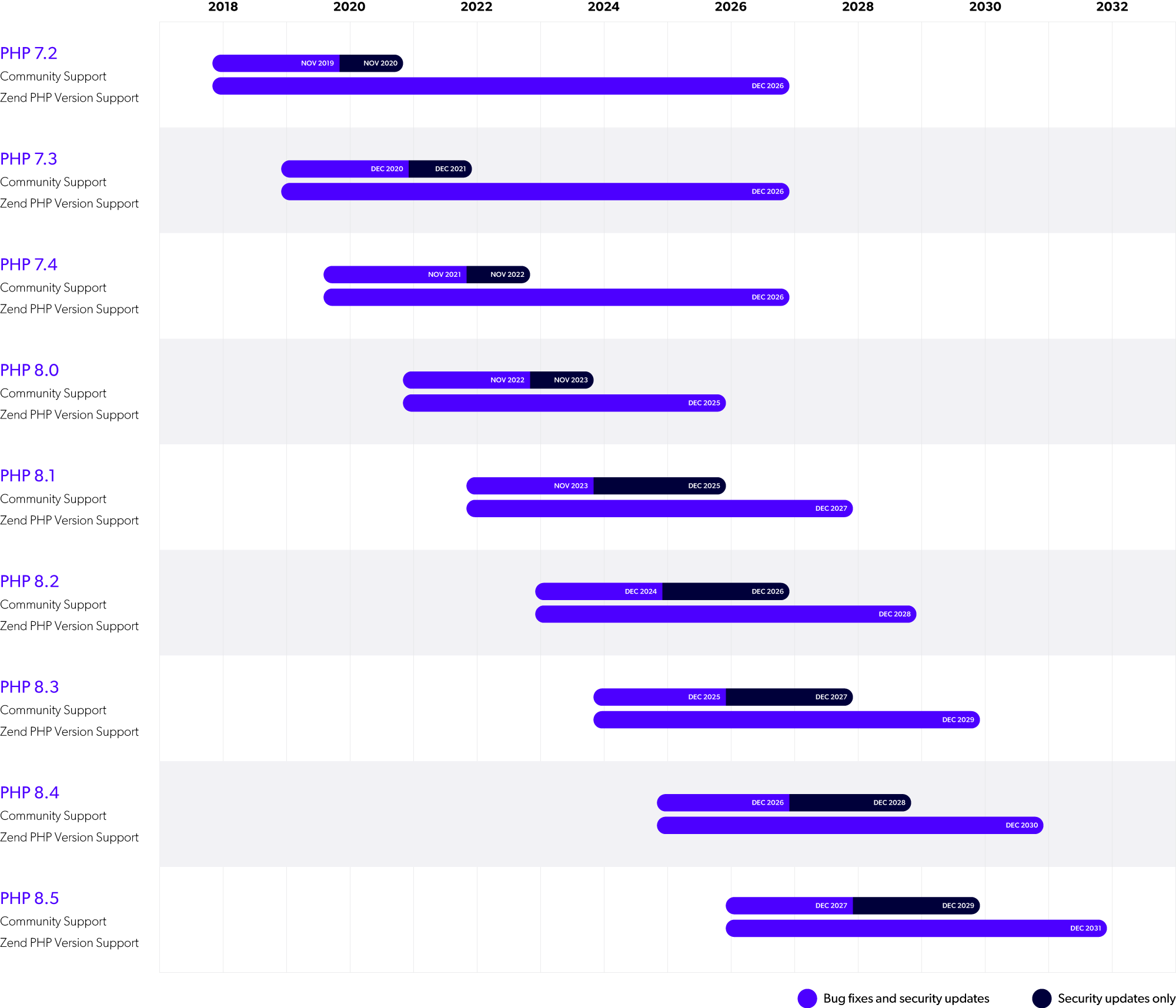
Explore PHP LTS for Government Web Services
Shift to Proactive Drupal Maintenance and Support
Sustainable operations require moving beyond reactive maintenance. Establish regular update cycles, routine system checks, and documented workflows to reduce variability. Consistency improves both response time and system reliability, helping you stay ahead of issues instead of responding after the fact.
To support this shift, teams can adopt centralized platforms that improve visibility and control. Observability tooling like ZendHQ help monitor PHP-based applications and streamline issue detection, while more comprehensive solutions like the Enterprise Web Platform provide a unified approach to managing, securing, and maintaining web environments at scale.
Regardless of your choice, these types of tools strengthen your Drupal maintenance and support model to create a more proactive, resilient approach.
Operationalize Security and Compliance
Security and compliance should be part of everyday operations, not separate initiatives. Integrating checks into existing workflows helps ensure that requirements are consistently met without adding extra overhead.
This includes ongoing validation, documentation of changes, and maintaining audit readiness. Embedding these practices into routine Drupal maintenance and support enables teams to stay aligned with evolving standards while reducing the burden of last-minute compliance efforts.
Back to topFinal Thoughts
The Drupal maintenance gap reflects years of growing complexity across government web services, driven by aging systems, evolving requirements, and limited resources. Without a structured approach to Drupal maintenance and support, this gap increases risk, slows response times, and makes it harder to maintain secure, compliant, and reliable services.
Teams that prioritize visibility, stabilize high-risk systems, and adopt proactive maintenance practices can regain control of their environments. A consistent, well-managed approach not only reduces operational risk but also creates a stronger foundation for modernization.
 Ongoing Support from Drupal Experts
Zend is proud to be a Drupal Sustaining Member, and we bring deep expertise supporting enterprise Drupal environments. Explore our full suite of PHP Professional Services, including PHP Long-Term Support, to secure and modernize your government web services.
Additional Resources
- Certification - Become a Zend PHP Certified Engineer
- Guide - PHP Versions: Performance, Security, and Feature Comparisons
- Guide - How to Develop Web Applications with PHP
- Blog - CMS or Framework: What's Best for Your PHP Application?
- Blog - PHP Maintenance and Tech Debt Trends
- Blog - Using a GitOps Model for Web App Development